
Here’s a scenario that plays out more often than most RPM vendors will tell you.
A pharmacy enrolls a patient in a remote monitoring program. The device ships. The patient is a 74-year-old woman managing hypertension and Type 2 diabetes, lives thirty minutes outside a small town, and has internet service that works fine when the weather is good. She takes her blood pressure every morning like clockwork. But at the end of the month, the transmission log shows eight days of data, not sixteen. The billing threshold isn’t met. No revenue. No clinical record of her readings. And nobody catches it until the next billing cycle.
The patient did everything right. The program failed her.
This isn’t a technology problem unique to rural areas. It’s a patient population problem. The people who most need continuous monitoring, older, managing multiple chronic conditions, living far from the nearest clinic, are also the least likely to have the home infrastructure that most RPM devices quietly assume they have.
What most RPM devices assume
The majority of remote monitoring devices on the market are Bluetooth-based. They’re designed to pair with a smartphone, sync through an app, and transmit readings over a home Wi-Fi network. In a suburb where the patient is 55, owns an iPhone, and has a 400 Mbps cable connection, that works fine.
In rural healthcare, you’re often working with a different patient entirely. Older adults, lower rates of smartphone ownership, internet connections that range from slow DSL to nothing at all. A device that depends on three things going right like Bluetooth pairing, app login, Wi-Fi transmission has three ways to fail silently.
And silent failure is the worst kind. The patient thinks she’s being monitored. You think you have a patient enrolled. The data just never arrives.
What cellular actually changes
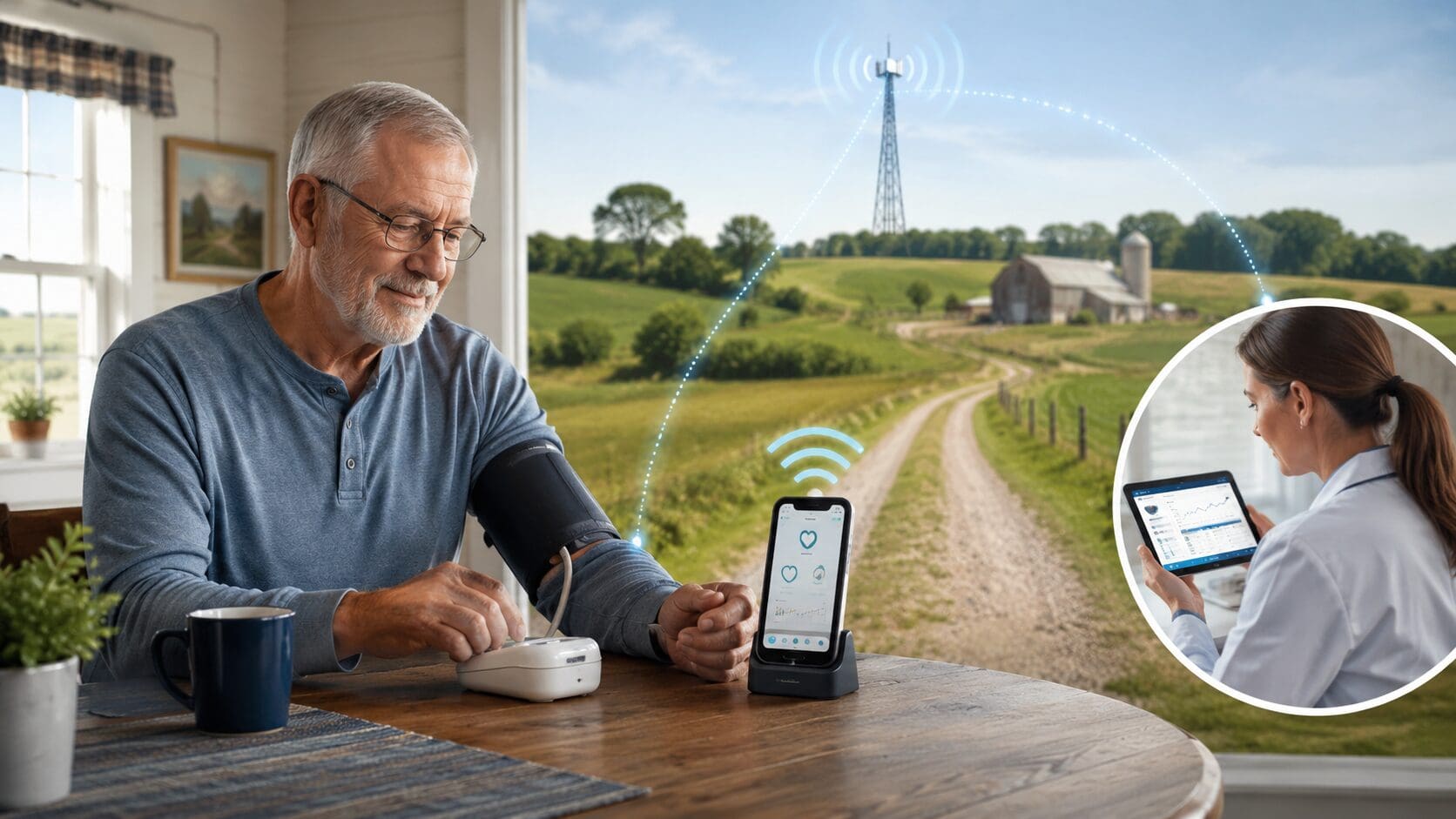
A cellular device has one job: take a reading, send it. There’s no pairing process, no app, no network password. The SIM card inside it connects to a mobile network the same way a cell phone does. The patient presses a button; the reading transmits; it appears in the clinical dashboard.
That simplicity isn’t a minor convenience. It’s the thing that makes consistent 16-day transmission achievable for rural patients who would struggle with any other setup.
It also removes a category of support burden that quietly eats pharmacist time. With a Bluetooth program, staff end up troubleshooting connection issues, walking patients through re-pairing steps, and chasing down missing data. With cellular, the most common call you get is “how do I replace the batteries.” That’s a much better use of everyone’s time.
Why consistent transmission is the whole point
Remote monitoring only works if the readings actually arrive, every day, across the month. A patient who transmits sixteen days out of thirty gives a clinician half a picture. A patient who transmits eight gives almost nothing. The gaps are not neutral. A missing week can hide a blood pressure trend that would have changed a medication decision.
The failure mode that should worry you is not the patient who stops taking readings. That one is visible, and you can intervene. The failure mode that should worry you is the patient who takes readings faithfully while the data silently fails to transmit. On your dashboard both look identical: no data. But one patient needs a phone call and the other needs a device that works.
Cellular devices do not guarantee a patient stays engaged. Engagement is a separate problem. What they remove is the scenario where a reading is taken and simply never arrives. For a rural Medicare panel, that removed failure mode is the difference between a program you can trust and a program that quietly underperforms.
Where cellular falls short
It would be dishonest not to say this clearly: cellular coverage in truly remote areas can be just as patchy as broadband. Parts of rural Appalachia, the Mountain West, and the Mississippi Delta have dead zones that no device connectivity choice fully solves. A multi-carrier SIM that hops between networks helps, and devices that store readings locally and sync when signal is available help further but if a patient lives in a genuine coverage gap, cellular isn’t a complete answer either.
For tech-comfortable patients who have reliable Wi-Fi and a smartphone, Bluetooth devices can offer more functionality: two-way messaging, patient-facing health dashboards, a wider variety of device types. Cellular isn’t universally superior. It’s specifically the right default for the patient profile most common in rural independent pharmacy practice.
The practical question
Before choosing an RPM device for your program, it’s worth asking one question about your actual patient panel: how many of them could realistically set up and maintain a Bluetooth-connected device on their own?
If the honest answer is “most of them,” Bluetooth is probably fine. If you’re working with a predominantly older, rural Medicare population, which describes most independent pharmacies in RHTP-targeted areas, cellular is the lower-risk choice. Not because it’s more sophisticated, but because it asks less of the patient.
The best clinical technology is the kind patients actually use consistently. In rural pharmacy RPM programs, that usually means cellular.
Frequently asked questions
What is the difference between cellular and Bluetooth RPM devices?
Cellular RPM devices have a built-in SIM and transmit readings over mobile networks independently, no Wi-Fi, smartphone, or app required. Bluetooth devices pair with a phone or tablet that then sends data over the internet. For rural patients without reliable broadband or smartphones, cellular removes significant barriers to consistent use.
Why does device type affect monitoring quality?
Continuous monitoring depends on readings arriving consistently across the month. Connectivity failures, missed Bluetooth pairings, Wi-Fi outages, and app problems can quietly interrupt that flow without anyone noticing. Cellular devices remove that category of failure, so the clinical record reflects what the patient actually did.
Are cellular RPM devices more expensive?
Generally, yes. The upfront device cost is higher because of the embedded SIM and cellular hardware. In most cases that cost is offset by better transmission rates and therefore more reliable monthly billing, but it’s a real factor in program budgeting.
Do cellular RPM devices need a data plan?
The cellular data plan is typically bundled into the device or program cost rather than being a separate patient expense. The patient doesn’t need their own cellular plan, the device has its own.
What should rural pharmacies prioritize in an RPM device?
Cellular connectivity, offline data storage that syncs when signal is available, and the simplest possible patient interface. For an older rural patient population, every step removed from the daily workflow directly improves compliance.